
The Foldable Phone Problem
Foldable phones revolutionised mobile design by introducing flexible displays. Samsung Galaxy Z Fold and Z Flip proved the concept. Yet foldables remain niche despite five years of development.
Why? The fold. A crease runs down the middle of the display, visible and tactile. The crease affects user experience negatively. Gaming on a folded phone means playing across the crease. Video watching splits the image awkwardly.
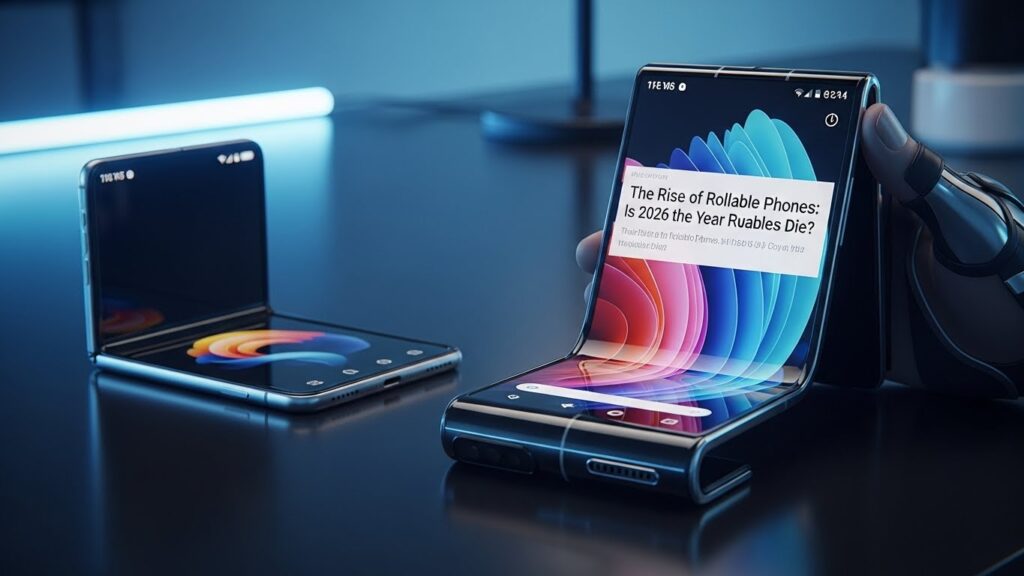
By 2026, rollable phones will emerge as a superior alternative. Rather than folding, screens roll up inside the chassis, remaining perfectly flat during normal use.
Understanding Rollable Phone Technology
How Rollable Screens Work
A rollable phone contains a flexible OLED display wound around a motorised spindle inside the device chassis. To expand the screen, the motor activates, unrolling the display outward.
Result: a phone that expands from 6.7″ to 8-9″ without any visible crease. The display remains perfectly flat and usable at any expansion level.
Mechanical Complexity
Rollable phones are mechanically more complex than foldables. The motor, spindle, and retraction mechanisms must function flawlessly for years. Failure means a dead phone.
Current prototypes demonstrate reliability, but real-world durability remains unproven. A rollable phone must survive 10,000+ expansion cycles reliably.
Display Quality Advantages
Unlike foldables with permanent creases, rollable displays show no crease because the display is flat when not expanded. This maintains display perfection.
When fully expanded, the display is marginally thicker (invisible to users) but optically perfect. No optical distortion from the crease visible on foldables.
2026 Rollable Phone Announcements
Samsung Rollable (Expected 2026)
Rumoured specifications: 6.7″ base screen, expands to 9.2″, Snapdragon 8 Gen 5, 12GB RAM, 512GB storage, $1,500-2,000 estimated price.

Expected launch: Q3-Q4 2026 (limited availability, high initial cost).
Status: Samsung demonstrated prototypes at tech conferences. Consumer launch timing uncertain, but 2026 seems realistic.
LG Rollable (Development Uncertain)
LG historically innovated display technology but exited smartphone manufacturing in 2021. Rollable phone development status unknown. Licensing LG display technology to other manufacturers is possible.
TCL Rollable Concept (Reference Design)
TCL (Chinese manufacturer) demonstrated a foldable phone concept at CES. No commercial launch date announced. Likely limited to Asian markets if produced.
Chinese Manufacturers (Oppo, Xiaomi Rumours)
Unconfirmed reports suggest Oppo and Xiaomi are researching rollable phones. Commercial launches delayed to 2027-2028 if confirmed.
Rollable vs. Foldable: The Showdown
Display Quality: Clear Rollable Win
Foldables: Permanent crease, visible and tactile. Display distortion is visible on the crease. User experience compromised.
Rollables: No crease. Perfectly flat display at all times. Optical quality is superior.
Durability: Uncertain for Rollables
Foldables: Proven durable (Galaxy Z Fold 5 exceeds expectations). Crease worsens over time, but the isplay survives 3-4 years reliably.
Rollables: Motor durability unproven. Early devices show promise, but long-term reliability data are unavailable. Risk of mechanical failure exists.
Price: Rollables Likely More Expensive
Foldables: Galaxy Z Fold 6 costs $1,899. Z Flip 6 costs $999.
Rollables: Samsung rollable estimated $1,500-2,000. Motor complexity increases manufacturing cost.
Usability: Rollables Superior for Certain Tasks
Foldables: Gaming and video watching are plagued by crease visibility. Productivity works well. Social media browsing is acceptable.
Rollables: Seamless expansion without disruption. Gaming, video, and productivity all benefit from an expanded screen. No crease interference.
Market Adoption Predictions
2026: Limited Launch, High Price
Estimated rollable phone sales: 500,000-1,500,000 units globally. Enthusiasts and tech early adopters only. Price premium deters mainstream adoption.
2027-2028: Accelerating Availability
Multiple manufacturers launch rollables. Prices drop to $1,200-1,500. Sales estimate: 5-10 million units annually. Still a premium segment, but growing.
2029-2032: Market Bifurcation
Rollables and foldables coexist, each serving different market segments. Rollables capture the “large screen expansion” market. Foldables capture the “compact form factor” market.
Estimated split: 30% rollable, 30% foldable, 40% traditional flat phones.
2033+: One Technology Dominates
Predictions diverge. Optimistic: rollables become standard due to superior display quality. Pessimistic: durability concerns and mechanical complexity keep the rollables niche. Most likely: both coexist indefinitely.
Will Rollables Really Kill Foldables?
The Case for Rollables Dominating
Superior display quality, no crease, seamless expansion—all advantages favour rollables. If reliability improves to match foldables, rollables become objectively superior.
Market dynamics: consumers prefer rollables if given a choice. Manufacturers profit more from rollables (higher pricing). The entire industry incentivises rollable adoption.
The Case for Foldables Surviving
Foldables are already proven. Millions sold. User base established. Samsung has invested billions in the foldable ecosystem and profitability.
Galaxy Z Flip serves a distinct use case: compact footprint. Rollables can’t match this (rollable needs internal space for motor). Foldable compact form factor survives.
Most Likely Reality
Rollables dominate the large-screen expansion market. Foldables survive in the compact segment. Both coexist for 10+ years, serving different customer preferences. Foldables don’t “die”—they specialise.
Technical Challenges Rollables Face
Motor Reliability
The motor must operate 10,000+ times reliably. Any failure means the phone is useless. Current motors show promise, but long-term reliability is proven.
Display Edge Protection
The display edge must be protected during rolling/unrolling. Any crease or damage disrupts image quality. Protective mechanisms add complexity and cost.
Software Adaptation
Apps must adapt to intermediate screen sizes (between 6.7″ and 9.2″). Developers must optimise layouts for multiple form factors. This increases development complexity.
Heat Dissipation
The motor and internal spindle generate heat. Dissipating this heat while maintaining a slim profile is challenging. Thermal management is critical.
Should You Wait for Rollable Phones?
If You’re a Foldable User
Stay with foldables in 2026. Rollables are first-generation with uncertain reliability. By 2028-2029, rollables will be mature enough to justify switching.
If You’re Considering First Foldable
Consider waiting for rollables. Galaxy Z Fold 6 remains excellent and performs well for another 3-4 years. By 2028, rollable prices drop, and reliability is proven.
If You Want the Latest Technology in 2026
Buy a premium flat phone (iPhone 18 Pro Max, Galaxy S26) and wait. Rollables aren’t mature enough. By 2027, first-generation issues surface, and you’ll know whether rollables are worth upgrading to.
Rollable Phone Pricing Strategy
2026 Launch: Premium Positioning
Samsung rollable is estimated $1,800-2,000. Positioned as an ultra-premium device. Limited production. Profit per unit maximised.
2027-2028: Price Adjustment
Prices drop to $1,200-1,500 as competition increases and manufacturing scales. Still a premium segment, but more accessible.
2030+: Mass Market Pricing
Estimated $800-1,200 by 2030-2032. Rollables become accessible to affluent mainstream consumers, not just early adopters and ultra-wealthy users.
Environmental Considerations
Complexity = Higher Failure Rate
Rollable phones are mechanically complex. More potential failure points. Higher e-waste if reliability doesn’t match user expectations.
Longer Device Lifespan = Lower Waste
If rollable phones convince users to keep devices 5-6 years (versus upgrading every 2-3 years), the environmental impact is positive despite complexity.
Recycling Challenges
Rollable phones are harder to disassemble for recycling. The motor mechanism complicates recycling processes. Recycling infrastructure must adapt.
FAQs
Q1: Will Rollable Phones Launch in 2026?
A: Likely yes, but limited availability. Samsung rollable will probably arrive in Q3-Q4 2026 in select markets. Mainstream availability delayed to 2027-2028.
Q2: Are Rollables More Durable Than Foldables?
A: Unknown. Motor reliability is unproven. Foldables have 5+ years of real-world data. Rollables have months. Wait 2-3 years for reliability data.
Q3: Can I Use a Rollable Phone as a Regular Phone Without Expanding?
A: Yes. Rollable phones work at base size (6.7-7″) without expanding. Expansion is optional for specific tasks.
Q4: Will Rollables Be Significantly More Expensive Than Foldables?
A: Initially, yes (£200-400 premium). By 2028-2030, pricing converges as manufacturing efficiency improves.
Q5: What If the Motor Fails on My Rollable Phone?
A: Phone is essentially bricked—expansion fails, but the base phone still works at 6.7″ size. Repair costs $500-1,500. An extended warranty is essential.
Q6: Is Rollable Display as Durable as Flat OLED?
A: No. Flexible OLED is more susceptible to damage than flat OLED. Scratches affect image quality. Protective cases are mandatory.
Q7: Should I Buy Foldable or Wait for Rollable?
A: Buy a foldable if you need a large screen now (2026). Wait for rollable if you can delay the upgrade until 2028-2029. Rollables will eventually dominate, but patience is required.
Related Articles for TechPurk
- The Rise of Rollable Phones: Is 2026 the Year Foldables Die?
- Humanoid Robots at Home: Are Tesla Optimus and Figure 01 Ready for 2026?
- Wi-Fi 8 is Coming: Why You Should Skip Wi-Fi 7 Routers in 2026
- The Death of Apps: Why “Agentic AI” Is the Biggest Trend of 2026
- Solid-State Batteries in 2026: Which Phones Will Finally Last a Week?
- Smart Glasses vs. VR Headsets: The 2026 Battle for Your Eyes
- 6G Networks Explained: How Fast Is It and When Can You Use It?
- Tech Trends 2026: 7 Innovations That Will Replace Your Smartphone
Final Verdict
Rollable phones are the future of expandable displays. They eliminate the crease that plagued foldables and offer superior display quality.
However, 2026 is too early for mainstream adoption. First-generation devices will have reliability issues. Motor durability remains unproven. Prices are astronomical.
Wait until 2028-2029 when second-generation rollables mature, and prices drop. Foldables don’t die—they specialise in compact form factors. But for large-screen expansion, rollables become the superior technology.
The age of foldables as the only expansion option ends in 2026. The age of rollables as the mainstream expansion choice begins around 2029-2030.