
The Promise of Humanoid Robots
For decades, robots remained confined to factories and laboratories. Humanoid robots—machines shaped like humans, capable of walking, manipulating objects, and performing household tasks—remained science fiction.
By 2026, this changes. Tesla Optimus, Figure 01, Boston Dynamics Atlas, and competitors launch commercial availability. Pricing ranges from $20,000 to $50,000. The question is no longer “will humanoid robots exist?” but “are they worth buying?”
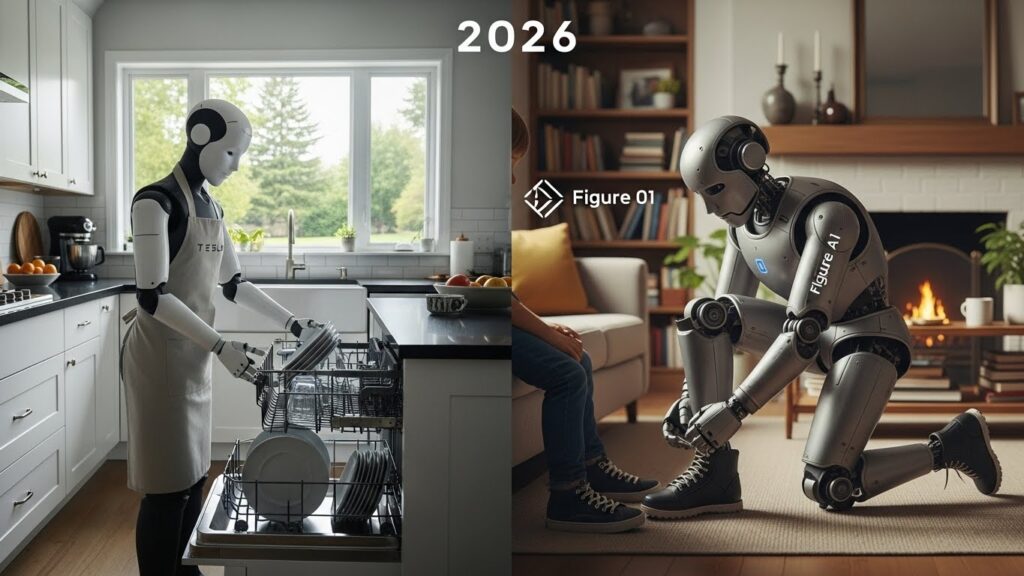
Meet the 2026 Humanoid Robots
Tesla Optimus (Formerly Tesla Bot)
Expected launch: Q2-Q3 2026.
Specifications: 5’8″ tall, 125 lbs, 40 joints, dexterous hands with individual finger control, vision-based navigation, on-board AI processing.
Pricing: $20,000-25,000 pre-order price. Actual retail likely $35,000-45,000 based on Tesla’s typical markup patterns.
Capabilities: Walking, stair climbing, object manipulation, folding laundry, loading/unloading dishwashers, basic cooking prep, garden maintenance.
Battery: 2.3 kWh battery, 8-hour operational runtime on full charge. Recharges via standard outlet (240V recommended for speed).
Figure 01 (Figure AI)
Expected launch: Q3-Q4 2026 (limited availability, pre-order 2025).
Specifications: 5’6″ tall, 110 lbs, specialized hands designed for precision manipulation, AI-driven task learning.
Pricing: $25,000-30,000 estimated (no official pricing released).
Capabilities: Warehouse sorting, object picking, manufacturing tasks, kitchen work (washing dishes, wiping counters), materials handling.
Focus: Figure prioritises industrial applications over household tasks. Home-use models arrive later than industrial versions.
Boston Dynamics Atlas (Gen 7)
Expected launch: Research/enterprise only in 2026 (not consumer available).
Specifications: 5’10” tall, advanced locomotion (parkour, complex terrain navigation), exceptional balance and agility.
Pricing: $100,000+ (industrial only).
Reality: Atlas remains research platform. Consumer availability delayed to 2027-2028 at earliest.
Other Competitors
Boston Dynamics Stretch: Mobile manipulation for warehouses and logistics. Consumer version unlikely until 2028+.
Sanctuary AI Phoenix: Canadian company developing humanoid for various sectors. 2026 status uncertain; likely delayed beyond 2026 launch window.
Unitree H1: Chinese humanoid, technically impressive but limited international availability. Availability in Western markets unclear for 2026.
What These Robots Can Actually Do (Honestly)
The Optimistic Assessment
Tesla Optimus and Figure 01 can perform genuine household and industrial tasks. They’re not sophisticated enough for complex cooking or childcare. But laundry folding, dishes, basic cleaning, yard work—these are legitimately possible.
Video demonstrations from 2025 show Tesla Optimus folding clothes, stacking boxes, watering plants. These aren’t flashy tasks, but they’re real labour saved.
The Realistic Limitations
Fragile objects: Robots struggle with eggs, glasses, delicate ceramics. Anything requiring precise force feedback remains challenging.
Unexpected situations: If you have kids’ toys scattered everywhere, the robot gets confused. Environments must be relatively organised. The robot can’t improvise like humans do.
Stairs and uneven terrain: Current models handle single stairs but struggle with multi-stair sequences or steep inclines. Basement or upstairs bedrooms require careful navigation or assistance.
Social integration: Robots don’t understand family dynamics. A robot can’t recognise “this is breakable, don’t touch,” or “this area is off-limits.” You must explicitly program boundaries.
Realistic Use Cases for 2026 Humanoid Robots
Best Case: Laundry and Dishwashing
These are structured, repetitive tasks with clear inputs and outputs. Robots excel here. A robot handling laundry saves 5-8 hours weekly for a family.
Economic calculation: $40,000 robot, 8 hours/week saved, 5 years lifespan = $3.50/hour cost. This breaks even at minimum wage equivalent. For high-income households, ROI is strong.
Viable Case: Yard Work and Garden Maintenance
Mowing lawns, weeding gardens, raking leaves—robots handle these adequately. Outdoor environments are less complex than indoor homes. Robots navigate more confidently.
Emerging Case: Elder Care and Mobility Assistance
Robots don’t replace human caregivers, but they assist. A robot can help lift an elderly person from a chair, bring medications, remind about meal times. This reduces strain on human caregivers.
Industrial Case: Warehouses and Manufacturing
Figure 01 and similar robots excel here. Sorting boxes, moving packages, repetitive manufacturing tasks—this is where 2026 robots deliver immediate ROI.
The Robot Ownership Reality Check
Initial Setup Requirements
You must prepare your environment. Clutter must be minimised. Stairs require special consideration. Fragile items must be secured. Your home becomes robot-optimised, which isn’t always convenient.
Ongoing Maintenance
Robots require regular maintenance: software updates, battery health monitoring, mechanical checks. Damaged components cost $500-2,000 to replace.
Extended warranty (recommended): $5,000-10,000 for 5 years. This adds significantly to total cost of ownership.
Learning Curve
Training a robot to handle your specific tasks takes time. Early versions require manual programming of complex tasks. By 2027-2028, AI learning improves, but 2026 robots need explicit instruction.
Real-World Labour Savings
Optimistic estimates: 8-12 hours/week labour reduction for household robots. Pessimistic: 3-5 hours/week (robot makes mistakes, requires supervision, causes problems requiring fixes).
Reality likely lands: 6-8 hours/week for most users after 3-6 months of learning.
Price-to-Value Breakdown
Tesla Optimus at $40,000
Robot cost: $40,000. Expected lifespan: 8-10 years (technology becomes obsolete by then, but hardware might last longer). Cost per year: $4,000-5,000.
Labour saved: 6-8 hours/week × 50 weeks/year = 300-400 hours/year. Labour cost per hour: $10-17/hour.
For households with domestic workers earning $15-20/hour, the robot pays for itself in 4-5 years. For households without domestic help, the calculation is different: the robot saves discretionary time, which varies in value.
Who Breaks Even?
High-income households: Robot pays for itself if your time is worth $40+/hour. The robot doing 8 hours/week of labour saves $320/week or $16,640/year. Payback period: 2.4 years.
Middle-income households: Robot breaks even if your time is worth $20-30/hour. Payback period: 5-8 years. Marginal economics—not compelling unless you genuinely dislike household tasks.
Lower-income households: Robot economics don’t work. You’re better off hiring household help or spending time on other productivity.
Market Adoption Predictions
2026: Early Adoption Phase
Estimated sales: 10,000-20,000 humanoid robots globally. Buyers: wealthy early adopters, tech enthusiasts, some businesses. Consumer market remains niche.
2027-2028: Expanding Awareness
Sales: 50,000-100,000 units annually. Price drops to $25,000-35,000 as manufacturing scales. Consumer interest grows but remains fringe.
2029-2032: Accelerating Adoption
Sales: 200,000-500,000 units annually. Prices reach $15,000-20,000. Mainstream awareness increases. Adoption becomes respectable but not yet standard.
2033+: Potential Mainstream Status
Estimated 20-30% of households in wealthy nations own humanoid robots by 2035-2040. Prices drop to $8,000-12,000. Similar to current adoption rate of smart home devices.
Reliability and Safety Concerns
Early Production Issues
First-generation robots (2026) will have reliability issues. Joint failures, software bugs, balance problems—these emerge in real-world usage despite testing.
Tesla and Figure AI warranty claims will be high in 2026-2027. Expect frequent service calls and component replacements.
Safety Around Children and Pets
A 110-150 lb robot moving around kids and pets carries injury risk. The robot might accidentally knock over a child or step on a pet. Supervision is mandatory.
Current robots lack human-level object recognition. They don’t reliably identify that a sleeping child shouldn’t be stepped over.
Security and Privacy
Robots navigate your entire home, accessing all areas. They’re essentially autonomous cameras. Data security and privacy are concerns. Hackers could theoretically control a robot or access video feeds.
By 2026, cybersecurity standards for robots are emerging but not bulletproof. Expect vulnerabilities and patches throughout 2026-2027.
Comparison: Robot vs. Hiring Help
| Factor | Robot | Hired Help |
|---|---|---|
| Upfront Cost | $40,000 | $0 |
| Monthly Cost | $100-200 (maintenance) | $1,500-3,000 |
| Yearly Cost | $1,500-2,500 | $18,000-36,000 |
| 5-Year Total | $47,500-52,500 | $90,000-180,000 |
| Quality of Work | Good (specific tasks) | Excellent (flexible) |
| Reliability | Poor initially, improving | Varies by person |
| Privacy | Potential concerns | Trust-dependent |
FAQs
Q1: Should I Pre-Order a Humanoid Robot in 2026?
A: Only if you’re wealthy and comfortable with early-adopter problems. For most people, wait until 2027-2028 when reliability improves and prices drop. First generation is always troublesome.
Q2: Will Humanoid Robots Replace Human Caregivers?
A: No. Robots assist human caregivers but don’t replace them. They’re tools for reducing workload, not substitutes for human judgment and compassion.
Q3: Can Humanoid Robots Do Cooking?
A: Basic cooking prep (chopping, stirring, heating) is possible. Complex cooking requiring taste adjustment and improvisation is beyond 2026 robots. Don’t expect meals ready when you get home.
Q4: What If My Robot Breaks Down?
A: Service calls cost $500-1,500. Waiting time: 1-4 weeks depending on availability. Factory service is most reliable; independent repair is risky. Extended warranty is strongly recommended.
Q5: Are Humanoid Robots a Good Investment?
A: Economically? Yes, for high-income households earning $75,000+/year. Emotionally? Maybe—depends on whether you enjoy household tasks or despise them. Practically? Wait for reliability to improve.
Q6: Will Robot Prices Drop Significantly?
A: Yes. Expect 40-50% price drops by 2028-2030 as manufacturing scales. Early buyers overpay. Wait 2-3 years for better value.
Q7: Which Robot Should I Choose: Tesla or Figure?
A: Tesla Optimus for household tasks. Figure 01 for industrial/warehouse use. Tesla has higher brand recognition and Gigafactory manufacturing scale. Figure has specialized expertise. Both are unproven in 2026.
Related Articles for TechPurk
- The Rise of Rollable Phones: Is 2026 the Year Foldables Die?
- Humanoid Robots at Home: Are Tesla Optimus and Figure 01 Ready for 2026?
- Wi-Fi 8 is Coming: Why You Should Skip Wi-Fi 7 Routers in 2026
- The Death of Apps: Why “Agentic AI” Is the Biggest Trend of 2026
- Solid-State Batteries in 2026: Which Phones Will Finally Last a Week?
- Smart Glasses vs. VR Headsets: The 2026 Battle for Your Eyes
- 6G Networks Explained: How Fast Is It and When Can You Use It?
- Tech Trends 2026: 7 Innovations That Will Replace Your Smartphone
Final Verdict
Humanoid robots arriving in 2026 are genuinely impressive technological achievements. They can perform real household tasks and deliver meaningful labour savings.
However, 2026 is early adoption. Reliability is questionable. Prices are high. For most people, waiting until 2028-2030 makes financial sense. For wealthy early adopters and tech enthusiasts, buying Tesla Optimus or Figure 01 in 2026 offers bragging rights and genuine utility.
These robots are the future of household automation. But the future arrives gradually, not suddenly. 2026 marks the beginning, not the endpoint.