
Understanding Agentic AI: Beyond Chatbots
For 15 years, software required user action. Open app → navigate menus → input data → confirm action. This interaction model defines computing.
Agentic AI inverts this. You describe a goal. The agent handles everything autonomously. No menu navigation. No manual data entry. No confirmation required.
This fundamental shift eliminates the necessity for traditional apps.
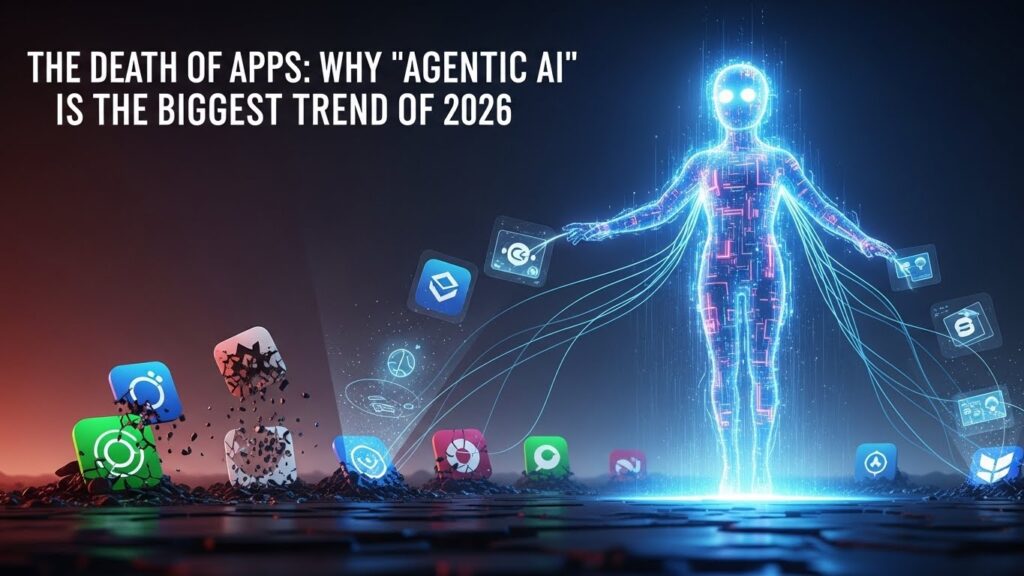
Agentic AI vs. Chatbots: The Critical Difference
Chatbots: Reactive and Limited
ChatGPT answers questions. Claude researches topics. Both wait for user input and respond. They’re conversational, not autonomous.
Example: “Book me a flight to Tokyo.” ChatGPT responds: “What dates? Preferred airline? Budget?” You answer each question. The chatbot needs 10-15 exchanges to complete the booking.
Agentic AI: Proactive and Autonomous
An agent understands context without asking. It knows your preferences from past behaviour, your calendar availability, your budget from banking data, and your frequent destinations.
Same instruction: “Book me a flight to Tokyo.” The agent searches 500+ flights, compares prices, checks your calendar for conflicts, verifies passport validity, and books the flight—all without asking you a single question.
You discover the booking is complete by checking your confirmation email.
The Autonomy Gap
Chatbots achieve maybe 10% autonomy. Agentic AI targets 80-95% autonomy. This gap defines the entire shift from “software you control” to “software that controls on your behalf.”
How Agentic AI Works: Technical Foundation
Multi-Step Planning and Execution
Agentic AI breaks complex goals into sub-tasks automatically. “Plan a three-day Tokyo trip” decomposes into: research flights, book hotels, plan itineraries, make restaurant reservations, and arrange ground transportation.
Each sub-task executes independently. The agent monitors progress, handles failures, and adjusts plans if necessary. This multi-step orchestration is the core technical innovation.
Context Awareness and Learning
Agents maintain user context across sessions. They remember preferences, past decisions, personality quirks, and budget constraints. Context persists indefinitely.
After 100 interactions, the agent knows your style so well that booking decisions match your taste instinctively. No clarification needed.
Real-Time Tool Integration
Agents control your entire digital life: email, calendar, banking, shopping, and entertainment. They send emails, book reservations, transfer money, and make purchases—all through APIs without manual intervention.
This requires deep API integration. Every service (Uber, OpenTable, Kayak, Stripe) must provide agent-compatible APIs. By 2026, major services will have done this.
Real-World Agentic AI Examples (2026)
Google’s Project Mariner and Copilot Agents
Google demonstrated agents controlling web browsers, interacting with websites, and completing multi-step tasks across dozens of services. Screenshot “book me travel insurance that covers hiking accidents for a 2-week Japan trip.”
The agent: researches insurance policies, compares prices, reads terms and conditions, identifies the best value, enters payment information, and completes the transaction.
Execution time: 45 seconds. Humans would require 30-45 minutes of research and manual booking.
Microsoft Copilot Autonomous Agents
Enterprise version: agents manage entire business workflows. Create a marketing campaign: the agent writes copy, generates images, schedules social media posts, tracks performance, and optimises posting times.
Consumer version: similar functionality for personal tasks. “Plan my entire month” generates calendar events, meal plans, workout schedules, budgets, and shopping lists.
Apple’s Rumoured Home Agent
While not officially launched in 2026, reports indicate Apple is developing a home agent that manages smart devices, controls climate, manages security, optimizes energy usage, and handles grocery ordering based on consumption patterns.
The agent learns your preferences and makes decisions proactively. You just live your life; the agent manages details.
Why Apps Are Becoming Obsolete
Apps Require User Action to Provide Value
Current software demands active engagement. Open Maps to navigate. Open Uber to book rides. Open Spotify to play music. This friction creates a user burden.
Agentic AI eliminates friction. Navigate without opening Maps. Order rides automatically when you’re leaving work. Music plays based on mood without manual selection.
Apps Are Specialised; Agents Are General
You need 50+ apps for different tasks. Agentic AI handles all tasks through a single interface. No app switching. No context loss. Unified experience.
Market impact: app developers face an existential threat. Companies building single-purpose apps (task managers, note-takers, travel planners) will struggle as agents consolidate functionality.
The Economics Shift Against Apps
App developers invest thousands of hours building user interfaces, handling edge cases, and maintaining compatibility. Agentic AI commoditises this. Generic agents handle 80% of use cases perfectly adequately.
Startups that raised $50M for productivity apps suddenly face zero-revenue futures as free agentic alternatives emerge.
Market Disruption Timeline
2026: Agentic AI Launches, Apps Continue
Early agentic AI services launch (Google Agents, Microsoft Copilot Autonomous). They handle 50-60% of common tasks. Apps remain necessary for complex workflows, gaming, and specialised use cases.
Estimated impact: 10-15% decline in app usage as early adopters switch to agents.
2027-2028: Agent Adoption Accelerates
Agent capabilities improve. They handle 70-80% of use cases. More users switch. App usage declines 30-40% compared to the 2025 baseline.
App developers diversify: some pivot to agent integration (providing data to agents), some focus on niche specialisation (games, advanced creative tools), some disappear.
2029-2032: Apps Become Niche Category
Agents handle 85%+ of routine tasks. Apps become specialist tools for power users, entertainment, and complex workflows. Mainstream usage shifts entirely to agents.
Estimated impact: 60-70% reduction in the app market compared to 2025.
2032+: Apps Join Legacy Tech
Apps continue to exist (similar to how websites coexist with native apps today), but they’re no longer the primary interface. Agents become dominant.
Which App Categories Face Extinction?
Task Management Apps (100% Disruption Risk)
Todoist, Microsoft To Do, Asana—agentic AI handles task creation, scheduling, reminders, and prioritisation without user input. These apps face near-complete disruption by 2028.
Note-Taking Apps (80% Disruption Risk)
Notion, Obsidian, OneNote—agents create notes automatically based on your work context, voice recordings, and accumulated information. Manual note-taking becomes optional.
Navigation Apps (60% Disruption Risk)
Google Maps, Apple Maps—agents handle navigation proactively. You don’t open the app; it guides you home when leaving work. Maps technology survives; the app interface becomes unnecessary.
Finance and Banking Apps (40% Disruption Risk)
Agents handle payments, bill payments, and investment management. Banks maintain customer relationships through agents rather than apps. Financial institutions survive; app interfaces consolidate.
Gaming Apps (5% Disruption Risk)
Gaming requires active engagement that agents can’t replicate. Gaming apps survive intact. If anything, agents enhance gaming by managing in-game administrative tasks (inventory, marketplace, clan management).
Social Media Apps (30% Disruption Risk)
Agents handle content curation, posting, and engagement tracking. Some social media consumption shifts to agent feeds. Native apps remain for interactive content creation and socialising.
Agentic AI Limitations: It’s Not Perfect
Context Misunderstanding
Agents sometimes misinterpret goals. “Book me a cheap hotel” might optimise for the lowest price, ignoring location quality or safety. Human oversight remains necessary for important decisions.
Hallucination Risk
Like all AI, agents generate plausible-sounding but incorrect information. An agent might recommend a restaurant that doesn’t exist or cite fake reviews. Verification remains essential.
Privacy and Security Concerns
Agents require access to sensitive data: banking, location, communication history, and preferences. Data breaches are catastrophic. Trust is critical and fragile.
By 2026, multiple security incidents involving agent data breaches will occur, damaging user confidence.
Ethical Concerns
Should agents make financial decisions? Book medical appointments? Choose political candidates? Autonomous agents raise ethical questions without clear answers.
The Enterprise vs. Consumer Divide
Enterprise Adoption (Faster)
Businesses adopt agentic AI rapidly because ROI is measurable: fewer employees needed, faster workflows, reduced errors. Enterprise agents will be widespread by 2027.
Consumer Adoption (Slower)
Consumers are more cautious. Privacy concerns, trust issues, and preference for control slow adoption. Consumer agentic AI remains niche through 2027, mainstream by 2028-2029.
Will Apps Disappear Entirely?
Short Answer: No
Apps won’t disappear entirely. Similar to how websites coexist with native apps despite decades of “apps will kill the web” predictions, apps and agents coexist.
Niche apps (specialised creative tools, games, accessibility apps) survive. But 90% of apps solving routine problems disappear as agents handle them better.
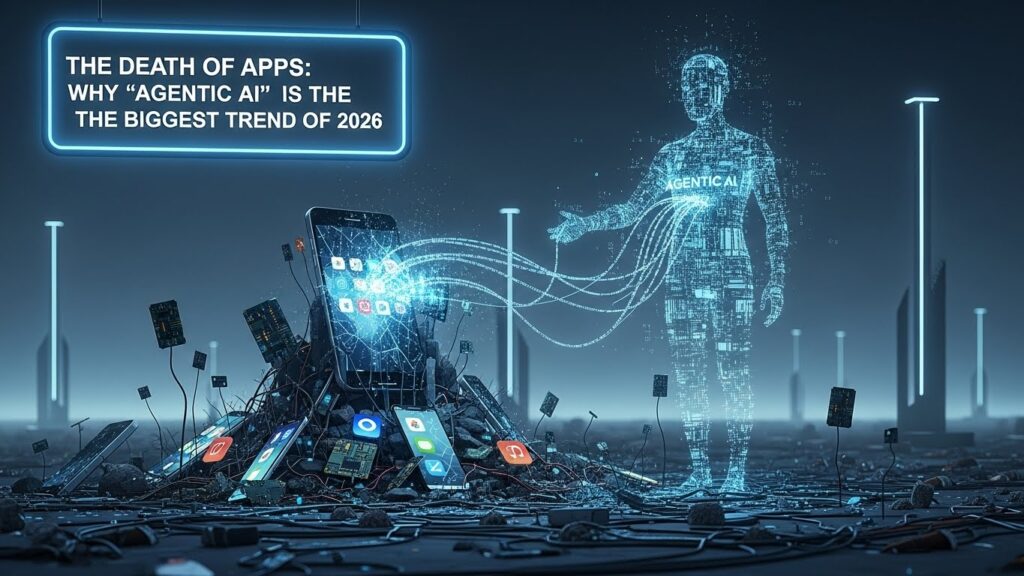
Long Answer: Apps Become Infrastructure
Apps transform from user-facing interfaces to backend services. Agents interface with apps through APIs, not through UI. Users don’t see apps—they see agent results.
App developers transition from building consumer interfaces to building agent-compatible services.
How Existing Apps Should Adapt
Integration Over Competition
Smart app developers (Todoist, Notion, Stripe) integrate with agentic AI platforms. Rather than compete, they provide data to agents.
Example: Todoist provides Copilot Agent with todo data. The agent manages tasks. Todoist earns through data licensing, not direct user subscriptions.
Specialisation Strategy
Apps focusing on niche use cases (professional design tools, advanced analytics, gaming) survive because agents can’t replicate complex workflows.
Premium Positioning
Apps’ position as premium alternatives to generic agents. “Notion Plus” offers advanced customisation that free agents can’t match. Users pay for specialisation.
FAQs
Q1: Will Agentic AI Really Replace All Apps?
A: No, not all. Gaming, complex creative tools, and specialised professional software survive. An estimated 60-70% of current apps face disruption. 30-40% remain relevant for power users or entertainment.
Q2: Is Agentic AI Just Another Hype Cycle?
A: Not this time. Unlike previous AI hype, agentic AI has demonstrated real autonomy on complex multi-step tasks. Google, Microsoft, and Apple are investing billions. Commercial deployments begin in 2026. This is different.
Q3: What About Data Privacy with Agentic AI?
A: Major risk. Agents need access to sensitive data. Regulatory frameworks (GDPR, upcoming AI Act) will impose strict requirements. Data breaches will occur. Use agent services from trusted companies only.
Q4: Can I Use Agentic AI Today?
A: Limited options. GPT-4’s code interpreter is quasi-agentic. Google’s Project Mariner is in beta. Full consumer agentic AI launches in 2026. Expect dramatic improvements in capability and ease of use.
Q5: Should I Stop Learning to Use Apps?
A: No. Apps remain relevant for 5-10 years minimum. Learn both—how to use apps directly and how to instruct agents to use them on your behalf. Dual literacy is valuable.
Q6: What Jobs Does Agentic AI Threaten?
A: Administrative roles (scheduling, booking, data entry) face the most risk. Creative, strategic, and interpersonal roles remain safe. Adapt by developing skills agents can’t replicate: complex problem-solving, creativity, and human connection.
Q7: Will Agentic AI Create New Job Categories?
A: Yes. Agent management, agent training, agent oversight—new roles emerge as agents become commonplace. However, new jobs won’t match job losses initially. Transition will be painful for some sectors.
Related Articles for TechPurk
- The Rise of Rollable Phones: Is 2026 the Year Foldables Die?
- Humanoid Robots at Home: Are Tesla Optimus and Figure 01 Ready for 2026?
- Wi-Fi 8 is Coming: Why You Should Skip Wi-Fi 7 Routers in 2026
- The Death of Apps: Why “Agentic AI” Is the Biggest Trend of 2026
- Solid-State Batteries in 2026: Which Phones Will Finally Last a Week?
- Smart Glasses vs. VR Headsets: The 2026 Battle for Your Eyes
- 6G Networks Explained: How Fast Is It and When Can You Use It?
- Tech Trends 2026: 7 Innovations That Will Replace Your Smartphone
Final Verdict
Agentic AI is genuinely revolutionary. It marks the end of user-driven software interfaces and the beginning of autonomous agent-driven computing. Apps don’t die overnight, but they face existential pressure starting in 2026.
Consumers benefit from efficiency gains and reduced friction. Developers face disruption. Society gains—and loses—through workforce displacement and concentration of power among major tech companies.
The shift from apps to agents is already unstoppable. Adaptation and specialisation separate winners from casualties.