
The Two Competing Visions of the Future
Two distinct technologies compete for wearable computing dominance in 2026: augmented reality (AR) glasses that overlay digital information onto the real world, and virtual reality (VR) headsets that replace reality entirely with digital environments.
AR glasses let you navigate a real street while directional arrows float in your vision. VR headsets immerse you in a completely digital Tokyo street created by artists.
Both technologies matured significantly by 2026. The question isn’t which exists—both do. The question is which becomes mainstream consumer technology.
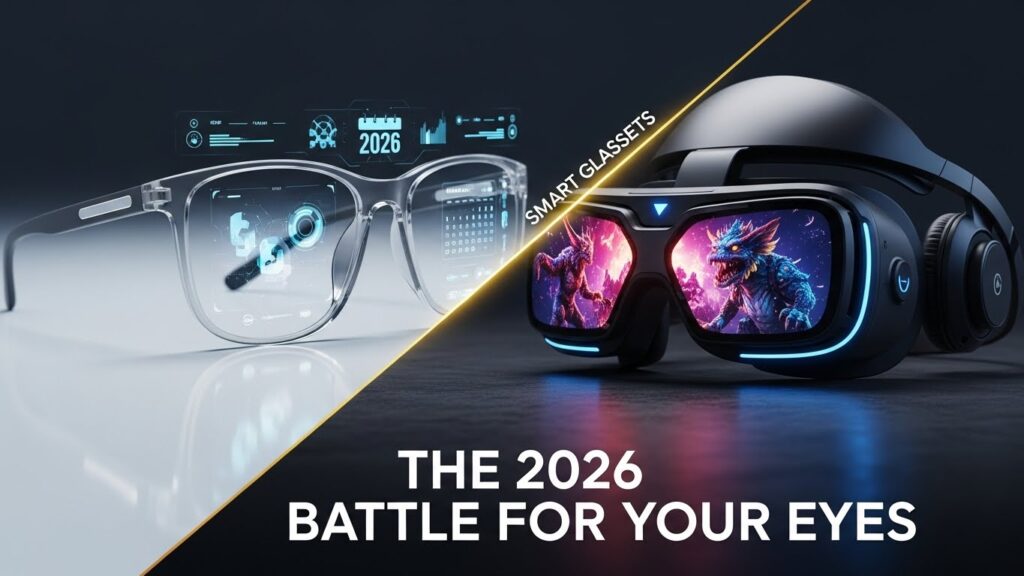
Smart Glasses (AR) Fundamentals
What AR Glasses Actually Do
Smart AR glasses project holographic displays directly into your field of view. You see the real world overlaid with digital information: navigation arrows, notifications, translations, price information, vital signs.
Unlike smartphone screens you hold up, AR glasses integrate seamlessly. You don’t look down—you look forward. Digital information appears where you’re looking.
2026 AR Glasses Devices
Meta Orion: Full-colour holographic displays, 4-hour battery, lightweight (150g), $3,500 starting price.
Apple Vision Air: Downsized Vision Pro to $1,999, lighter (280g), dual display technology, ecosystem integration.
Google Glass Enterprise Edition 3: Enterprise-focused, industrial applications, not consumer market.
Qualcomm Snapdragon AR Glasses (Reference Design): Multiple manufacturers produce compatible glasses using Qualcomm chipsets, priced $1,200-2,500.
AR Use Cases That Matter
Navigation: Turn-by-turn directions overlay on real streets. No screen glancing required.
Translation: Real-time text translation overlays foreign language signs and menus. Travel without language barriers.
Productivity: Open multiple virtual screens while sitting in a coffee shop. Work on three documents simultaneously, invisible to anyone watching.
Social Enhancement: Real-time information about people you meet (LinkedIn profile, common interests). Networking becomes data-enhanced.
VR Headsets Fundamentals
What VR Headsets Actually Do
VR headsets completely replace your visual and audio environment with digital alternatives. Strap on a headset, and you’re transported to another world.
High-end VR achieves near-photorealism. You can’t distinguish rendered environments from reality. Audio is spatial—sound comes from specific directions, creating immersive presence.
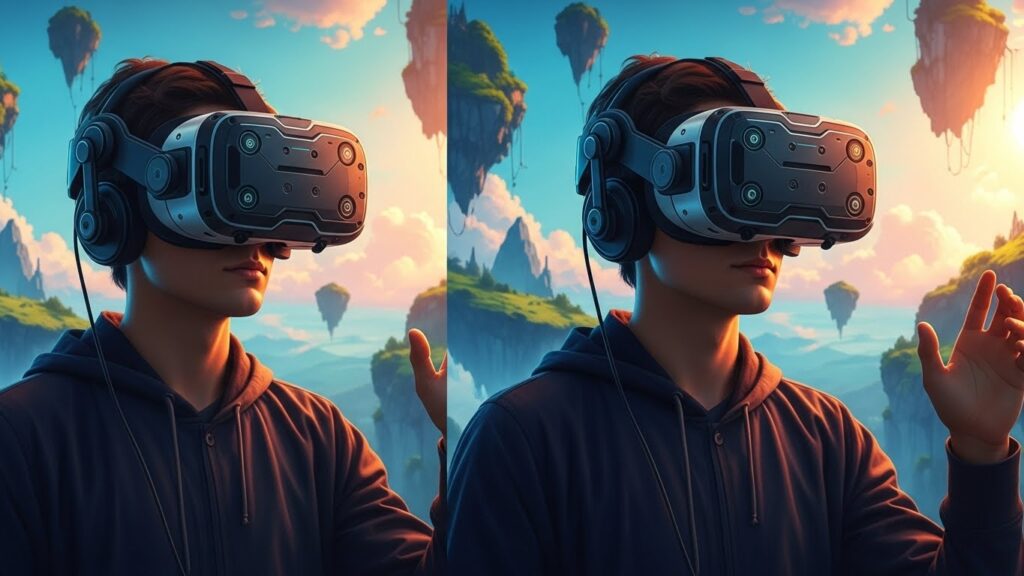
2026 VR Headsets
Meta Quest 4: Standalone device (no PC required), 120Hz display, 3-hour battery, $499 starting price. Most popular consumer VR device.
PlayStation VR2: Console-based, exceptional graphics, exclusive game library, $549 with PS5 requirement.
Valve Index 2: PC-based, highest graphical fidelity, $899, requires a high-end gaming PC.
HTC Vive Focus: Enterprise-focused VR, industrial training applications.
VR Use Cases That Matter
Gaming: Immersive games where you physically move to aim, dodge, and interact. Gameplay is fundamentally different from screen-based gaming.
Training and Simulation: Doctors practice surgery in risk-free virtual environments. Pilots simulate dangerous maneuvers. The military trains for combat scenarios.
Entertainment: Virtual concerts, sports watching from any seat, immersive movies.
Social: Virtual worlds where avatars meet, interact, and conduct business. Metaverse applications (though often oversold).
Direct Comparison: AR Glasses vs. VR Headsets
| Aspect | AR Glasses | VR Headsets |
|---|---|---|
| Price | $1,500-3,500 | $499-2,000 |
| Battery Life | 3-4 hours | 2-3 hours |
| Weight | 120-200g | 500-700g |
| Daily Wearability | Excellent (light, all-day) | Poor (heavy, bulky) |
| Real-World Awareness | 100% (see reality) | 0% (fully immersed) |
| Social Acceptance | Growing (looks like glasses) | Poor (sci-fi helmet appearance) |
| Gaming Quality | Moderate (overlay-based) | Excellent (full immersion) |
| Productivity Use | Excellent (see real world while working) | Limited (complete isolation) |
| Enterprise Adoption | Growing (field work, logistics) | Established (training, simulation) |
Why AR Glasses Win for Everyday Use
The Real-World Awareness Advantage
VR headsets isolate you completely. While entertaining for gaming, isolation is impractical for daily life. You can’t navigate a city, interact with friends, or maintain situational awareness.
AR glasses keep you grounded in reality while enhancing it with digital information. You see traffic, people, and hazards while getting navigation guidance. This makes AR glasses practical for everyday wear.
Battery Life and Comfort
AR glasses weigh 150g (similar to regular glasses). VR headsets weigh 600g (similar to a grapefruit on your head). After 30 minutes, the VR headset causes neck strain and fatigue.
Battery life: AR glasses last 4+ hours with light use. VR headsets last 2-3 hours maximum. For daily use, AR’s superiority is obvious.
Social Acceptability
AR glasses look like prescription glasses or sunglasses. Socially acceptable in public. VR headsets look like sci-fi helmets. Wearing one in public attracts stares and raises concerns.
This social factor shouldn’t matter, but it does. Technology adoption depends partly on social comfort. AR wins here decisively.
Why VR Headsets Win for Entertainment and Gaming
Complete Immersion Is Irreplaceable
VR transports you to another world completely. This immersion is impossible to replicate with AR overlays on reality. For entertainment—games, movies, social experiences—complete immersion is superior.
Established Content Library
VR has 5+ years of game and entertainment content development. Thousands of titles exist. AR’s content library is emerging but sparse.
Proven Gaming Performance
VR gaming is genuinely fun and engaging. PlayStation VR2 and Meta Quest 4 sales prove market demand. AR gaming remains experimental and less compelling.
Market Adoption Predictions (2026-2032)
AR Glasses Adoption
2026: 2-3 million AR glasses sold globally (early adopters, professionals). Consumer market remains nascent.
2028: 10-15 million annual sales. AR glasses become visible in urban areas. Adoption accelerates among professionals (delivery, logistics, healthcare).
2030: 50-80 million annual sales. AR glasses reach mainstream adoption. Standard accessory for knowledge workers.
2032: 150+ million installed base. AR glasses are commonplace in developed nations. Considered normal technology, similar to smartphones.
VR Headset Adoption
2026: 5-8 million units sold annually. The gaming niche remains the primary market.
2028: 10-15 million units. Adoption plateaus—growth slows significantly.
2030: 15-20 million units. VR market stagnates. Gaming enthusiasts sustain demand, but mainstream adoption never materialises.
2032: 20-25 million installed base. VR remains a niche entertainment product, similar to gaming consoles today.
The Hybrid Future: AR + VR Integration
Devices Converging
By 2028-2030, AR and VR will converge into a single device. Imagine glasses that display AR overlays normally but can switch to full VR immersion when desired.
Technical challenges remain, but prototypes exist. Apple Vision Air and next-generation Meta Orion are exploring hybrid functionality.
Use Case: Hybrid Workflow
Morning: AR mode for navigation and productivity. Afternoon: VR mode for a meeting in a virtual conference room. Evening: gaming in full VR immersion. Single device handles all scenarios.
Enterprise vs. Consumer Market Split
Enterprise Loves AR
Logistics, healthcare, and manufacturing—AR’s real-world awareness makes it invaluable for field work. The technician views repair instructions overlaid on the equipment. Surgeon sees patient anatomy overlay during surgery.
Enterprise AR adoption accelerates faster than consumer adoption. By 2027, millions of enterprise AR glasses will be in use globally.
Consumer Loves VR (But Only for Gaming)
VR’s killer app is gaming. PlayStation VR2’s success proves this. However, gaming alone doesn’t sustain mainstream adoption. Without compelling non-gaming use cases, VR remains an enthusiast niche.
Why AR Likely Wins the Mainstream Market
Practical Utility Over Entertainment
Humans value practical utility over entertainment long-term. AR makes daily life more efficient. VR entertains but doesn’t improve productivity.
Wearability Matters
AR glasses are wearable all day. VR headsets are session devices. All-day wearability wins for mainstream adoption. Comfort and weight determine whether people actually use devices.
Real-World Grounding
Consumers want to stay connected to reality. Completely losing awareness (as VR requires) is uncomfortable for extended periods. AR maintains reality connection while enhancing it.
Price and Accessibility
VR Headsets Are Cheaper Today
Meta Quest 4 starts at $499. AR glasses start at $1,500. Price advantage favors VR for early adopters with limited budgets.
AR Prices Will Drop
By 2028-2030, AR glasses will cost $500-800 as manufacturing scales. VR prices will plateau (already hit maturity). Price convergence favors AR for mainstream adoption.
FAQs
Q1: Which Should I Buy in 2026: AR Glasses or a VR Headset?
A: Depends on use case. For gaming and entertainment: VR headset (cheaper, better games). For productivity and daily use: AR glasses (lighter, more practical). If budget allows, buy VR now; upgrade to AR when prices drop in 2028.
Q2: Will VR Ever Reach Mainstream Adoption?
A: Unlikely as a primary device. VR will remain an enthusiast niche (like high-end gaming today). An estimated 5-10% of the population adopts VR long-term, versus 40-50% for AR.
Q3: Are AR Glasses Comfortable for All-Day Wear?
A: 2026 models are improving, but not perfect. Most users can wear 4-6 hours comfortably. By 2028-2030, all-day comfort becomes standard as design matures.
Q4: What’s the Biggest Limitation of AR Glasses Today?
A: Display brightness and field-of-view. Outdoor use is difficult in bright sunlight. The field of view is narrower than natural vision. These limitations improve annually; by 2028-2029, they’re mostly solved.
Q5: Can I Watch Movies on AR Glasses?
A: Yes, but it’s inferior to VR or traditional screens. AR displays appear relatively small. For movies, VR headsets or large screens are superior. AR excels for productivity, not entertainment.
Q6: Will My Smartphone Become Obsolete with AR Glasses?
A: Not immediately. AR glasses and smartphones have co-existed for 10+ years. Eventually, AR glasses will replace phones as the primary computing device, but the transition takes time.
Q7: What About Privacy Concerns with AR Glasses?
A: Legitimate concern. AR glasses with cameras record everything you see. This data could theoretically be misused. Regulatory frameworks (GDPR, upcoming AI regulations) will impose strict requirements on data collection.
Related Articles for TechPurk
- The Rise of Rollable Phones: Is 2026 the Year Foldables Die?
- Humanoid Robots at Home: Are Tesla Optimus and Figure 01 Ready for 2026?
- Wi-Fi 8 is Coming: Why You Should Skip Wi-Fi 7 Routers in 2026
- The Death of Apps: Why “Agentic AI” Is the Biggest Trend of 2026
- Solid-State Batteries in 2026: Which Phones Will Finally Last a Week?
- Smart Glasses vs. VR Headsets: The 2026 Battle for Your Eyes
- 6G Networks Explained: How Fast Is It and When Can You Use It?
- Tech Trends 2026: 7 Innovations That Will Replace Your Smartphone
Final Verdict
AR glasses will win the mainstream consumer market by 2032. Practicality, wearability, and real-world utility position AR as the primary computing interface for daily life.
VR headsets survive as a specialised gaming and entertainment device, similar to gaming consoles today. Both technologies coexist, but AR dominates mainstream adoption.
The battle for your eyes isn’t really a battle—it’s a partition. AR wins daily productivity; VR wins immersive entertainment. Both have futures, just in different market segments.