
Understanding 6G: The Next Frontier in Wireless Technology
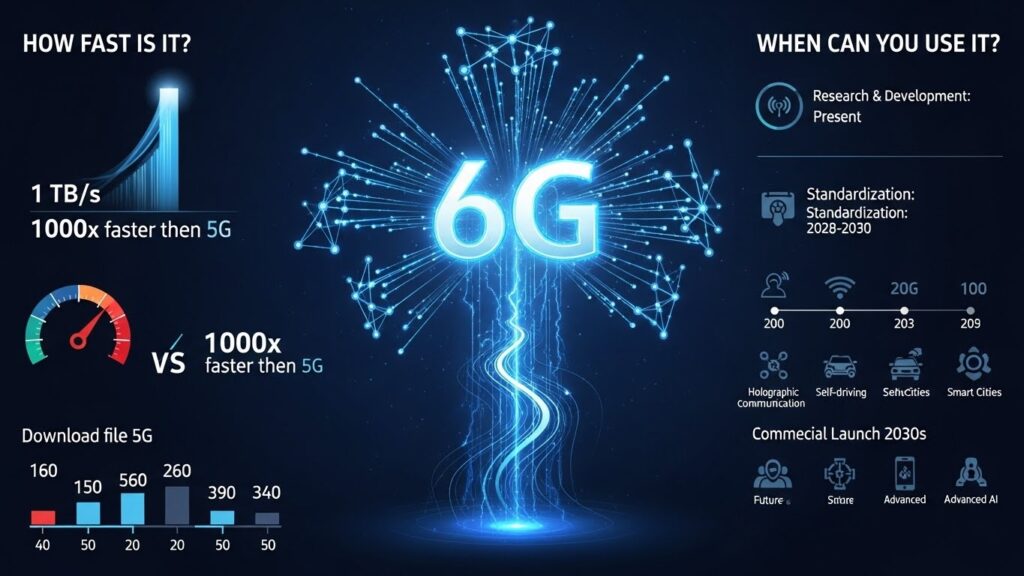
6G is the wireless standard following 5G, theoretically delivering speeds of 1 terabit per second (Tbps). That’s 100 times faster than 5G’s theoretical maximum of 10 gigabits per second.
But speed alone doesn’t define 6G. The real revolution is latency reduction, energy efficiency, and quantum integration. By 2026, standards will be finalised. By 2030, limited commercial deployment begins.
This guide explains 6G’s actual capabilities, separates hype from reality, and clarifies why 5G devices will coexist with 6G for a decade.

What Is 6G? Beyond Speed Metrics
6G Speed Explained: Terabit-Per-Second Reality
1 Tbps means downloading a 1GB movie in 0.008 seconds. Current 5G achieves this in 0.8 seconds. The practical difference? Nearly imperceptible for everyday tasks.
Video streaming (4K requires 25 Mbps), web browsing (10 Mbps), video calls (2.5 Mbps)—6G overkill for current applications. The speed advantage emerges when new use cases arrive: real-time 8K holographic video, instantaneous cloud processing, simultaneous multi-device streaming.
Latency: The Real Game-Changer
5G achieves 1-10 millisecond latency. 6G targets 0.1 milliseconds. This microsecond difference enables applications impossible on 5G.
Autonomous vehicles: At 100 mph, a 0.1ms latency gap means a 0.14-inch difference in braking distance. Multiplied across millions of vehicles, it reduces accidents dramatically.
Remote surgery: Surgeons control robotic arms in real-time with zero perceptible delay. Current 5G introduces noticeable lag; 6G eliminates it.
Brain-computer interfaces: Neural signals require near-zero latency. 6G enables responsive neural implants that react to thoughts instantaneously.
Energy Efficiency: More Speed, Less Power
5G consumes significant power. 6G redesigns the entire architecture for efficiency. Devices transmit the same data using 50% less energy. Theoretical estimate: 6G consumes equivalent power to 4G while delivering 100x faster speeds.
This solves the IoT problem. Billions of sensors can run on tiny batteries lasting years instead of months.
6G Release Date and Timeline: Realistic Expectations
2026: Standards Finalisation, No Consumer Access
By the end of 2026, the 3GPP (standards body) will finalise 6G specifications. Major frequencies allocated. Hardware requirements defined. Prototype chips demonstrated by TSMC, Samsung, and Intel.
Consumer access in 2026? Zero. No phones, no routers, no consumer devices will connect to 6G networks in 2026.
What arrives in 2026 is 6G-capable hardware preparation. Phones released in 2026 may include 6G antennas and modems to future-proof devices. Network infrastructure deployment hasn’t begun.
2027-2029: Infrastructure Rollout Begins
Telecommunications companies install 6G base stations in major cities. Deployment concentrates in wealthy nations: the USA, Japan, South Korea, and Western Europe. Developing nations wait 3-5 years longer.
Limited 6G networks launch in dense urban centres (Tokyo, Seoul, New York, London) by 2028. Coverage remains sparse—you can access 6G occasionally, not reliably.
2030+: Mainstream Availability
By 2030, 6G networks will cover 30% of populated areas in developed nations. Mainstream devices released 2030 onwards include 6G as standard. By 2032-2033, 6G coverage reaches 80% in developed nations.
Developing nations receive 6G by 2035-2040.
Why 6G Takes So Long to Arrive
Technical Challenges: Higher Frequencies, Greater Obstacles
6G operates at millimetre-wave and sub-terahertz frequencies (300-1000 GHz). These frequencies don’t penetrate walls well. 5G already struggles with wall penetration; 6G worse.
Solution: Deploy more base stations. Coverage requires 10x more hardware than 5G. Cost: estimated $2-4 trillion globally to fully deploy 6G infrastructure.
Spectrum Allocation Challenges
Governments must allocate spectrum for 6G. Unlike previous generations, 6G operates in frequencies with existing uses (satellite communication, astronomy, weather radar). International agreements are required to prevent interference.
The 2026 ITU World Radiocommunication Conference allocated 6G frequencies, but enforcement remains ongoing. Some countries prioritise domestic needs over global coordination.
Backward Compatibility Requirements
5G networks must coexist with 6G for 10-15 years. Carriers maintain 4G, 5G, and 6G infrastructure simultaneously, increasing operational costs. Device manufacturers must support 4G/5G/6G fallback for reliability.
This “multi-generational sprawl” slows deployment. Clean-slate infrastructure would be faster but impractical.
6G Frequency Bands and Geographic Allocation (2026)
Allocated Frequencies
Sub-100 GHz band: 54-71 GHz (primary carrier allocation).
Terahertz band: 300-430 GHz (experimental, limited range).
Regional variations: Japan prioritises 15-30 GHz for 6G. China proposes an additional 37-42 GHz allocation. The USA focuses on 71-100 GHz. No unified global standard—carriers adapt by region.
Geographic Deployment Priority (2026-2027)
Tier 1 (2027): Tokyo, Seoul, Shanghai, San Francisco, London.
Tier 2 (2028-2029): Major metropolitan areas in developed nations.
Tier 3 (2030-2031): Secondary cities in developed nations, primary cities in emerging markets.
Tier 4 (2032+): Rural areas, developing nations.
How 6G Differs from 5G: Technical Deep Dive
Antenna Technology: Massive MIMO to Holographic Beamforming
5G uses Massive MIMO (Multiple-Input Multiple-Output) with 64-256 antenna elements. 6G escalates this to 1000+ antenna elements using holographic beamforming.
Practical benefit: signal quality improves dramatically. Penetration through walls increases. Energy efficiency maximizes.
Modulation Schemes: Denser Data Encoding
5G uses 256-QAM (Quadrature Amplitude Modulation). 6G scales to 4096-QAM, encoding more data per signal. Risk: environmental interference corrupts the signal faster at higher densities.
Mitigation: artificial intelligence predicts interference and adapts modulation in real-time. Self-healing networks adjust automatically.
Integration with AI and Quantum Computing
6G networks include on-network AI processing. Machine learning tasks execute at the network edge, not the cloud. Latency drops to milliseconds.
Quantum-safe encryption becomes mandatory. As quantum computers threaten current encryption, 6G deploys quantum-resistant algorithms from day one.
6G Use Cases That Justify the Investment
Autonomous Systems: Vehicles, Drones, Robots
Autonomous vehicles require constant communication with infrastructure. 6G’s low latency enables vehicle-to-everything (V2X) communication that feels native, not remote-controlled.
Current 5G-based autonomous systems suffer noticeable latency. Drivers perceive slight delays in steering correction. 6G eliminates this.
Immersive Reality: Holographic Communication
Imagine video calls where the other person appears life-sized, three-dimensional, in your room. Current technology requires cloud processing, causing lag. 6G bandwidth enables real-time holographic projection.
Practical application: surgery training, remote collaboration, and family reunions for separated loved ones.
Edge AI and Ubiquitous Computing
Every device becomes an AI processor. Smartphones, wearables, sensors—all run machine learning locally. 6G provides bandwidth for continuous model updates without flooding networks.
Outcome: personalised AI that adapts instantly to user preferences without uploading data to the cloud.
Neural Interfaces and Brain-Computer Communication
Neuralink and similar systems require reliable, low-latency connectivity. 6G enables neural implants that respond to thoughts in real-time without perceptible delay.
Application: paralysed individuals regain mobility, stroke survivors recover cognitive function, and disabled people achieve full autonomy.
When Will 6G Actually Reach Consumers?
Realistic Timeline for Average Users
2026: Zero consumer access. Specification finalised only.
2028: Limited access in major cities for early adopters (5G in major cities arrived 2019-2020). Cost: $5,000-10,000 for early 6G devices.
2030: Mainstream devices with 6G. Prices comparable to current flagship phones ($1,000-1,500).
2032: 6G standard feature on all new devices. 5G is still primary for 80% of users.
2035-2040: 6G dominates. 5G is relegated to legacy devices and rural areas.
Budget Estimate: What Does 6G Deployment Cost?
Global infrastructure: $2-4 trillion (spectrum acquisition, base station installation, network management systems).
Per-carrier investment (USA example): $80-150 billion for nationwide 6G deployment over 8 years.
Device upgrades: Consumers spend $15-20 trillion upgrading from 5G to 6G phones over 2030-2040 (assuming 2 billion upgrades).
Should You Wait for 6G Phones in 2026?
Short Answer: No
5G phones purchased in 2026 will remain useful through 2035-2040. 6G networks won’t exist for 4-5 years. Waiting means using suboptimal devices for years.
Purchase flagship phones with 6G antennas (if available in 2026) for future-proofing, but don’t delay 5G adoption for missing 6G networks that don’t exist yet.
Long Answer: Hybrid Strategy
2026-2029: Use 5G phones. Enjoy current network speeds. No reason to upgrade.
2030-2031: Upgrade to 6G-capable devices when networks launch in your city. Don’t upgrade earlier unless you’re an early adopter with money to burn.
2032+: 6G becomes standard. All new devices support it. Upgrade on a normal 3-4 year cycle.
6G vs. Satellite Internet: Why Both Matter
Different Solutions, Complementary Technology
Satellite connectivity (arriving 2026) solves the “no dead zones” problem. 6G solves the “maximum speed” problem. They’re not competing—they’re complementary.
Satellite provides reliable but slower connectivity (50-100 Mbps) everywhere. 6G provides ultra-fast connectivity (1 Tbps) in populated areas. Together, they create seamless global connectivity.
By 2030, devices automatically switch between 6G, 5G, and satellite based on availability and speed requirements.
The Quantum Computing Connection
Why 6G Must Be Quantum-Safe
Quantum computers threaten current encryption. By 2030-2035, quantum computers capable of breaking RSA encryption will become available. 6G networks launch with quantum-resistant encryption from day one.
This future-proofs the network against decryption attacks from quantum adversaries. 5G networks are gradually upgraded with quantum-safe encryption, but existing infrastructure remains vulnerable.
Practical Implication
Banking, government, and military communications benefit most from 6G’s quantum-safe infrastructure. This accelerates 6G adoption in security-critical sectors.
FAQs
Q1: Can I Use 6G on My 5G Phone?
A: No. 5G hardware lacks 6G antennas, modems, and frequencies. Your 5G phone will never access 6G networks. You must purchase a 6G-capable device around 2030-2031.
Q2: Will 6G Cost More Money Per Month?
A: Likely yes, initially. 6G network infrastructure is expensive. Carriers will charge premium rates for early access (2030-2032). By 2035-2040, prices stabilise as competition increases.
Q3: Is 6G Dangerous? What About Radiation?
A: 6G operates at higher frequencies than 5G, but with lower power. Radiation exposure is comparable to 5G, well below safety limits. No evidence suggests 6G poses health risks beyond 5G.
Q4: Which Countries Get 6G First?
A: Japan, South Korea, the USA, and China lead 6G deployment. Europe follows 1-2 years later. Developing nations wait 5-10 years. India, Brazil, and Mexico will access 6G around 2035.
Q5: Will 5G Networks Disappear?
A: No. 5G remains as a fallback for 15-20 years. Carriers maintain 4G, 5G, and 6G simultaneously through 2040-2050. Eventually, 4G and 5G deactivate, but not for a decade after 6G mainstream deployment.
Q6: Can I Get 6G in Rural Areas?
A: Not soon. Rural 6G deployment begins 2035-2040. Satellite internet remains primary connectivity for rural users through the 2030s. By 2040, widespread 6G access reaches rural regions.
Q7: What’s the Biggest 6G Innovation Beyond Speed?
A: Quantum-integrated security. 6G is first-generation designed from inception to resist quantum computing attacks. This fundamental security improvement, not speed, is the revolutionary aspect.
Related Articles for TechPurk
- The Rise of Rollable Phones: Is 2026 the Year Foldables Die?
- Humanoid Robots at Home: Are Tesla Optimus and Figure 01 Ready for 2026?
- Wi-Fi 8 is Coming: Why You Should Skip Wi-Fi 7 Routers in 2026
- The Death of Apps: Why “Agentic AI” Is the Biggest Trend of 2026
- Solid-State Batteries in 2026: Which Phones Will Finally Last a Week?
- Smart Glasses vs. VR Headsets: The 2026 Battle for Your Eyes
- 6G Networks Explained: How Fast Is It and When Can You Use It?
- Tech Trends 2026: 7 Innovations That Will Replace Your Smartphone
Final Verdict
6G is real, not hype. Standards finalised in 2026. Limited deployment begins 2028-2030. Mainstream access arrives 2030-2035.
For average users, 6G matters less than 5G did. Speed is already adequate. Latency improvements benefit niche use cases (autonomous vehicles, remote surgery, neural interfaces) more than everyday browsing.
Don’t rush to 6G. Enjoy 5G phones through 2030. Upgrade when networks arrive in your city, around 2031-2033.