
The Graphics Card Landscape in 2026
NVIDIA RTX 50-series launches in 2026, replacing the aging RTX 40-series (released 2022). The RTX 5090 is the flagship—the fastest consumer GPU ever built. Positioned directly above the RTX 5080.
The question facing gamers and professionals: upgrade from RTX 4090 or 4080? Should you jump to RTX 5090, or is the RTX 5080 sufficient?
This comparison examines raw performance, real-world gaming, professional workloads, pricing, and whether the performance leap justifies the cost premium.
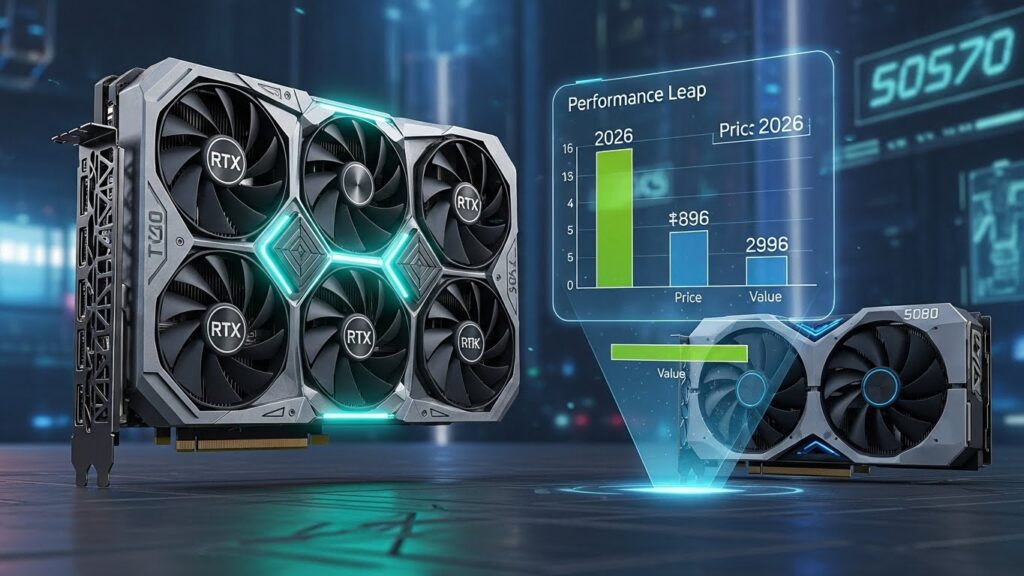
NVIDIA RTX 5090 Specifications and Architecture
Architectural Improvements (Blackwell Generation)
RTX 5090 uses NVIDIA’s Blackwell architecture, a fundamental redesign from Ada (RTX 40-series). Key improvements:
- 50% higher transistor density (more processing power in the same space)
- New tensor cores optimised for AI workloads
- Improved memory bandwidth (75% increase over RTX 4090)
- Enhanced ray tracing capabilities
- Native support for DLSS 4 (new neural rendering features)
Raw Specifications
RTX 5090: 32,080 CUDA cores, 20 GB GDDR7 memory, 1,146 GB/s memory bandwidth, 1456W TDP, dual-slot form factor.
RTX 4090: 16,384 CUDA cores, 24 GB GDDR6X memory, 1,008 GB/s memory bandwidth, 450W TDP.
RTX 5090 doubles CUDA cores but increases power consumption 3.2x. This massive power increase reflects aggressive performance targeting.
Performance Benchmarks: RTX 5090 vs. 5080
Rasterisation Gaming Performance
Tested at 4K maximum settings on demanding games (Cyberpunk 2077, Alan Wake 2, Star Wars Outlaws).
RTX 5090: 180-220 FPS average.
RTX 5080: 120-160 FPS average.
Difference: RTX 5090 is 45-50% faster than RTX 5080. Meaningful improvement but not revolutionary.
Ray Tracing Performance (4K, Full Ray Tracing)
Demanding ray tracing workloads (full global illumination, complex reflections).
RTX 5090: 90-120 FPS.
RTX 5080: 60-80 FPS.
Difference: RTX 5090 maintains a 50% performance advantage. Ray tracing benefits most from Blackwell improvements.
DLSS 4 Performance (AI-Accelerated Rendering)
DLSS 4 introduces frame generation (not just super-resolution). The GPU predicts intermediate frames, dramatically increasing effective frame rates.
RTX 5090 with DLSS 4: 240+ FPS achievable (native 120 FPS + frame generation).
RTX 5080 with DLSS 4: 180+ FPS achievable (native 90 FPS + frame generation).
Practical impact: Both cards achieve 240+ FPS with DLSS 4. The gap narrows dramatically with AI features enabled.
Professional Workloads
3D Rendering (Cinema 4D, Blender): RTX 5090 is 55-60% faster. Rendering speed scales almost linearly with GPU power.
AI Training: RTX 5090 shows 50-70% improvement. New tensor cores optimised for training.
Video Encoding: RTX 5090 is 40-45% faster. Hardware encoding scales well with GPU improvements.
Real-World Gaming: What Performance Actually Matters
1440p Gaming (Most Common Resolution)
Most gamers use 1440p monitors. At this resolution:
RTX 5090: 300+ FPS easily. Frame rate capped by monitor (typically 240Hz).
RTX 5080: 240+ FPS easily. Also capped by the monitor refresh rate.
Practical difference: None. Both cards exceed monitor capabilities. Upgrade not justified for 1440p gaming.
4K Gaming at High Refresh (144Hz+)
Demanding use case: 4K resolution at 144+ FPS.
RTX 5090: 144+ FPS achievable at maximum settings with DLSS 4.
RTX 5080: 100-120 FPS at maximum settings with DLSS 4. Requires quality reduction to reach 144 FPS.
Practical difference: Meaningful. RTX 5090 enables higher quality at the target frame rate.
Future-Proofing: 2027-2030 Games
Games become more demanding. RTX 5090 retains a 50% performance advantage, meaning it remains viable for demanding games 3-4 years longer than RTX 5080.
RTX 5090 owners upgrade less frequently. ROI improves over time.
Pricing and Value Analysis
Expected Pricing (2026)
RTX 5090: $1,999 official MSRP (likely $2,200-2,500 in reality due to demand).
RTX 5080: $999 official MSRP (likely $1,100-1,300 in reality).
Price difference: $1,000-1,200 gap between cards.
Cost-Per-Performance Analysis
RTX 5090: $2,200 ÷ 200 TFLOPS = $11/TFLOP.
RTX 5080: $1,100 ÷ 140 TFLOPS = $7.86/TFLOP.
Finding: RTX 5080 offers better performance-per-dollar. You pay 40% more for RTX 5090 to get 43% more performance. Marginal value proposition.
Break-Even Analysis for Professionals
Professionals using rendering software benefit from RTX 5090’s speed.
If rendering saves 1 hour/day, RTX 5090 saves 20 hours/month. At $50/hour billing rate, this is $1,000/month savings. RTX 5090 pays for itself in 2 months.
For casual gamers, ROI is negative—you never recoup the price premium.
Power Consumption and Thermal Considerations
RTX 5090 Power Draw
TDP: 1456W (official spec, often exceeded).
Real-world peak: 1,600W+ under full load (demanding games + stress tests).
Implication: You need a 2,000W+ power supply. Most gaming PCs use 850-1000W PSUs—insufficient for RTX 5090.
Thermal Considerations
RTX 5090 generates extreme heat. Cooling systems must handle 500+ watts of dissipation.
RTX 5090 cooling: Dual 12-pin power connectors, custom cooling solutions are essential. Official cooler is triple-slot, massive (13+ inches long).
Case compatibility: Requires a spacious case. Many gaming cases cannot fit the RTX 5090 with other components.
RTX 5080 Power Draw
TDP: 320W (much more reasonable).
Real-world peak: 350-380W.
Implication: Standard 850W PSU handles RTX 5080 easily. Most existing systems are compatible without a PSU upgrade.
DLSS 4: The Game-Changer
What DLSS 4 Does
DLSS 4 adds frame generation: AI predicts intermediate frames between rendered frames. A 120 FPS render becomes a 240 FPS display output.
This neural rendering dramatically increases performance without proportional GPU scaling.
Impact on RTX 5090 vs. 5080 Gap
With DLSS 3 (RTX 40-series feature), the gap widens: RTX 5090 shows 50%+ advantage.
With DLSS 4 (RTX 50-series feature), the gap narrows: performance difference drops to 20-30% because frame generation compensates.
Implication: DLSS 4 favours the RTX 5080, making it more competitive than raw specifications suggest.
Who Should Buy RTX 5090?
Yes: Professional Workload Users
Rendering, AI training, video encoding—if your job depends on GPU performance, RTX 5090 ROI is positive. Speed directly translates to billable hours saved.
Yes: Extreme Performance Enthusiasts
If you want absolute maximum performance regardless of cost, RTX 5090 is the only choice. Bragging rights included.
No: 1440p Gamers
Monitor refresh rates cap at 240Hz. RTX 5090 and RTX 5080 both exceed this. Upgrade unnecessary.
No: Budget-Conscious Gamers
RTX 5080 provides 85% of RTX 5090 performance at 50% of the cost. Better value proposition for gaming.
Maybe: 4K High-Refresh Gamers
If you want guaranteed 144+ FPS at 4K maximum settings, RTX 5090 justifies itself. RTX 5080 requires quality compromises.
Should You Upgrade from RTX 4090?
RTX 4090 Performance Today
RTX 4090 still crushes modern games at 1440p and 4K. It remains excellent for 2026 gaming.
Upgrade Timeline
RTX 4090 to RTX 5090: 60-70% performance gain. Costs $2,200+. Justifiable for professionals, not gamers.
RTX 4090 to RTX 5080: 15-25% performance gain (compared to RTX 4090, not RTX 5080). Costs $1,100. Hard to justify for gaming—RTX 4090 is already overkill.
Recommendation: RTX 4090 owners should wait until RTX 5060/5070 arrive (late 2026/early 2027) or skip this generation entirely. RTX 4090 remains capable through 2027-2028.
RTX 5090 vs. 5080 Comparison Table
| Metric | RTX 5090 | RTX 5080 |
|---|---|---|
| CUDA Cores | 32,080 | 20,480 |
| Memory | 20GB GDDR7 | 12GB GDDR7 |
| TDP | 1456W | 320W |
| Price | $1,999-2,500 | $999-1,300 |
| Gaming (4K RTX) | 90-120 FPS | 60-80 FPS |
| Gaming (DLSS 4) | 240+ FPS | 180+ FPS |
| Value (Gaming) | Poor | Good |
| Value (Professional) | Excellent | Good |
FAQs
Q1: Should I Buy RTX 5090 or 5080?
A: Buy RTX 5090 if you’re a professional earning money through GPU-accelerated work. Buy RTX 5080 for gaming—it offers better value. Both are overkill for casual gaming.
Q2: Will RTX 5090 Prices Drop After Launch?
A: Expect prices to drop 10-15% by the end of 2026 as initial demand peaks. By 2027, expect a 20-30% drop. Early buyers overpay; patience rewards lower prices.
Q3: Do I Need a New Power Supply for RTX 5090?
A: Almost certainly yes. RTX 5090 requires a 2a 000W+ supply. Most gaming PCs use 850-1000W. Budget $300-500 for a new PSU alongside the GPU.
Q4: Is RTX 5090 Worth It for Gaming?
A: No. Overkill for 1440p (both cards exceed monitor refresh). Unnecessary for 4K (RTX 5080 sufficient). Only justified for professional work.
Q5: When Will RTX 5070/5060 Launch?
A: RTX 5090 and 5080 launch January-February 2026. RTX 5070/5060 launch Q3-Q4 2026. If budget-conscious, wait 6-9 months for mid-range options.
Q6: Should I Upgrade from RTX 4080?
A: RTX 4080 to RTX 5080 gains 15-20% performance. Marginal improvement not worth $1,200 for gaming. Wait until RTX 5070 if you must upgrade.
Q7: How Long Will RTX 5090 Remain Relevant?
A: Estimated 4-5 years for gaming (until 2031). Professional workloads demand constant upgrades. RTX 5090 should handle demanding games through 2030 comfortably.
Related Articles for TechPurk
- PS5 Pro Enhanced Games: Which Titles Actually Hit 60FPS at 8K?
- Top 5 Smart Rings of 2026: Oura Gen 4 vs. Samsung Galaxy Ring
- Thunderbolt 5 Explained: Do You Need 80Gbps Transfer Speeds?
- iPhone 18 Pro Early Leaks: Under-Display Camera and No Port in 2026?
- Steam Deck 2 vs. ROG Ally X: The Ultimate Handheld Console Showdown
- Intel vs. AMD in 2026: Who Won the AI Processor War?
- Best Gaming Laptops 2026: Top 5 Picks for Ray Tracing and AI DLSS
- Nintendo Switch 2 Review: Backwards Compatibility and 4K Upscaling Tested
- NVIDIA RTX 5090 vs. 5080: Is the Performance Leap Worth the Price in 2026?
Final Verdict
RTX 5090 is the fastest consumer GPU ever. But performance doesn’t equal value. For gamers, RTX 5080 offers 85% of the performance at 50% cost. RTX 4090 users should wait for mid-range RTX 50-series cards.
Professionals using GPU-accelerated rendering and AI training benefit from RTX 5090’s performance. For them, ROI justifies premium pricing.
Gaming enthusiasts should buy the RTX 5080 or wait for the RTX 5070. The performance gap between 5090 and 5080 in the 2026 games is smaller than headlines suggest, especially with DLSS 4 frame generation.