
The Mini-LED Monitor Price Collapse
Mini-LED monitors revolutionised gaming displays when they launched in 2024-2025. Local dimming zones provide OLED-like contrast without OLED burn-in risk. However, pricing remained premium ($1,500-2,500).
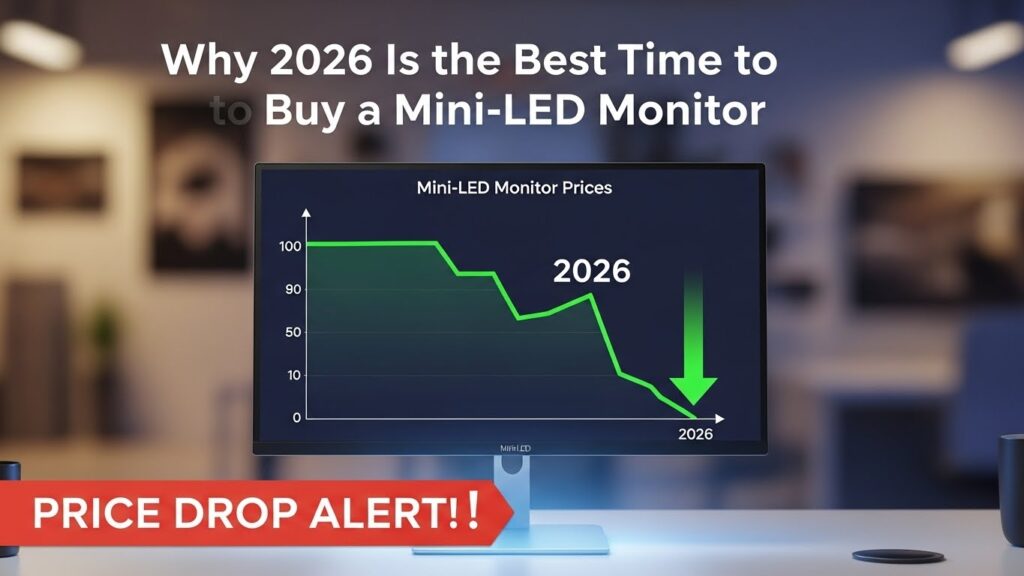
By 2026, prices will collapse dramatically. Entry-level mini-LED available $699-899. Premium models drop from $2,000+ to $1,200-1,500. This is the best time to buy mini-LED gaming monitors.
Understanding Mini-LED Technology
What Is Mini-LED?
Mini-LED displays use thousands of tiny LED backlights (instead of traditional edge-lit or full-array backlights). Each section independently dims or brightens, achieving OLED-like contrast.
Practical benefit: Deep blacks (backlights off) coexist with bright highlights (backlights on). Picture quality rivals OLED but without burn-in risk.
Local Dimming Zones
Budget mini-LED: 500-1,000 dimming zones.
Mid-range mini-LED: 1,000-2,000 zones.
Premium mini-LED: 2,000+ zones (approaching OLED quality).
More zones = better contrast and fewer edge effects (halos around bright objects on dark backgrounds).
Mini-LED vs OLED
Mini-LED advantages: No burn-in, cheaper, brighter peak brightness (beneficial for HDR), longer lifespan.
OLED advantages: Perfect blacks (no local dimming artefacts), faster response time, thinner panel.
For gaming, mini-LED is a superior value. OLED remains superior in image quality but costs 30-50% more.
Why Prices Are Dropping in 2026
Manufacturing Scale
Mini-LED production ramped dramatically in 2025. By 2026, multiple manufacturers (ASUS, MSI, Dell, LG, Samsung) will compete aggressively. Competition drives prices down.
Market Oversupply
Manufacturers overproduced mini-LED monitors. 2025 demand didn’t materialise as expected (early adoption slower than projected). By 2026, inventory excess forces price cuts.
New Technology Arriving
MicroLED (even better than mini-LED) arriving 2026-2027. To clear inventory, manufacturers reduce mini-LED prices aggressively.
This creates a window: mini-LED extremely good value, but will become obsolete by 2027-2028.
Best Mini-LED Monitors to Buy in 2026
#1 — ASUS ProArt PA348 (27″ Mini-LED, $899)
Specifications:
- 27″ 4K (3840×2160) resolution.
- 1,152 local dimming zones.
- 144Hz refresh rate.
- 1ms response time.
- 100% Adobe RGB colour space.
- Peak brightness: 1,000 nits.
2024 price: $1,599. 2026 price: $899 (44% drop).
Verdict: Exceptional value. Professional-grade colour accuracy + gaming-class responsiveness. Best overall mini-LED for balance of features and price.
#2 — MSI MPG 321UR-QD (32″ Mini-LED, $1,299)
Specifications:
- 32″ 4K resolution.
- 1,440 local dimming zones.
- 120Hz refresh rate.
- 1.5ms response time.
- DCI-P3 98% colour gamut.
- Peak brightness: 1,200 nits.
2024 price: $1,999. 2026 price: $1,299 (35% drop).
Verdict: Excellent large-format option. 32″ immersive gaming experience. Brightness is exceptional for HDR gaming.
#3 — Dell UltraSharp 4K Mini-LED (27″, $749)
Specifications:
- 27″ 4K resolution.
- 768 dimming zones (entry-level mini-LED).
- 60Hz refresh rate.
- 5ms response time.
- Professional calibration factory.
- Peak brightness: 800 nits.
2024 price: $1,299. 2026 price: $749 (42% drop).
Verdict: Best budget entry to mini-LED. Professional-oriented. Not ideal for competitive gaming (60Hz) but excellent for productivity and casual gaming.
#4 — LG UltraGear Mini-LED (27″ 1440p, $599)
Specifications:
- 27″ 1440p (2560×1440) resolution.
- 576 dimming zones.
- 240Hz refresh rate.
- 1ms response time.
- 98% DCI-P3 colour.
- Peak brightness: 900 nits.
2024 price: $1,099. 2026 price: $599 (45% drop).
Verdict: Best gaming-focused mini-LED. 240Hz for competitive gaming. 1440p resolution optimises frame rate. Excellent value at $599.
#5 — ASUS ROG Swift 4K Mini-LED (32″, $1,499)
Specifications:
- 32″ 4K resolution.
- 1,584 dimming zones.
- 144Hz refresh rate (G-Sync support).
- 1ms response time.
- 135% sRGB colour gamut.
- Peak brightness: 1,400 nits.
2024 price: $2,499. 2026 price: $1,499 (40% drop).
Verdict: Premium gaming option. Largest selection, exceptional brightness, gaming-optimised features. Best for enthusiasts with a budget.
Mini-LED vs OLED vs LCD Comparison
| Feature | Mini-LED | OLED | LCD (Edge-lit) |
|---|---|---|---|
| Price 2026 | $600-1,500 | $2,000-3,500 | $300-800 |
| Contrast Ratio | 100,000:1 | Infinite (perfect blacks) | 1,000:1 |
| Response Time | 1-2ms | 0.1-0.3ms (fastest) | 2-5ms |
| Brightness (Peak) | 1,000-1,400 nits | 700-1,000 nits | 300-500 nits |
| Burn-in Risk | No | Yes (mitigation improving) | No |
| Lifespan | 8-10 years | 5-7 years (OLED degrades) | 8-12 years |
| Power Consumption | 60-80W | 40-50W | 30-40W |
| Best For | Gaming + professional | Gaming premium | Casual gaming, productivity |
When to Buy Mini-LED vs Wait for MicroLED
Buy Mini-LED Now If:
- You need a monitor replacement immediately.
- Budget $600-1,500 range acceptable.
- Want a gaming monitor with exceptional image quality.
- Don’t mind potential 2027 obsolescence.
Wait for MicroLED If:
- You can delay the purchase for 12-18 months.
- Budget allows $2,000+ premium products.
- Want cutting-edge technology that lasts longer.
- Willing to pay a premium for next-generation.
Honest Assessment
Mini-LED in 2026 is an exceptional value. Buy now. MicroLED launches 2027+ at premium prices. Mini-LED remains viable through 2029-2030, even after MicroLED arrives (will be slower adoption).
Real-World Gaming Performance
Fast-Paced Gaming (Competitive Shooters)
Mini-LED 240Hz @ 1440p (LG UltraGear)is perfect for competitive gaming. 1ms response time is adequate for esports. Local dimming improves visual clarity in dark areas (competitive advantage for spotting enemies).
Single-Player Gaming (Story-Driven)
Mini-LED 4K @ 144Hz (ASUS ProArt) is excellent for story games where frame rate is less critical. Exceptional image quality enhances immersion. 1,152 dimming zones provide a cinematic visual experience.
Professional Work + Gaming
Mini-LED with professional calibration (Dell UltraSharp) supports colour-critical work during the day, gaming at night. Versatility is valuable for content creators.
Buying Guide: Which Mini-LED for You
Budget-Conscious ($599-799)
LG UltraGear 1440p ($599) or Dell UltraSharp ($749). Excellent value. Capable gaming performance at the entry price point.
Mainstream Gamer ($899-1,299)
ASUS ProArt 4K ($899) or MSI 32″ ($1,299). Balance of gaming performance, image quality, and price. Solid choice for most users.
Enthusiast ($1,499+)
ASUS ROG Swift 4K ($1,499). Maximum features, brightness, size. Premium but justified for serious gamers.
Professional + Gaming
Dell UltraSharp or ASUS ProArt. Professional calibration + gaming capability. Versatile for dual workflows.
2026 Mini-LED Market Landscape
Supply Normalisation
2025 oversupply will be corrected by mid-2026. Prices stabilise, then gradually increase slightly as inventory depletes. Best prices available Q1-Q2 2026 (right now).
Competitive Pressure
Multiple manufacturers (ASUS, MSI, Dell, LG, Samsung, Acer) are competing aggressively. Innovation and pricing battles benefit consumers. Q2-Q3 2026 shows the most competitive pricing.
Refresh Cycles
2026 mini-LED models are a mature iteration (not first-generation). Reliability proven. Firmware stable. Good time to buy established models rather than the newest 2027 variants.
FAQs
Q1: Is Mini-LED Really Worth Premium Over LCD?
A: Yes. Image quality difference is dramatic. Local dimming eliminates the washed-out blacks of LCD. Contrast vastly superior. For gaming and professional work, upgrading is worthwhile.
Q2: Will Mini-LED Prices Drop Further in 2026?
A: Marginal further drops likely (5-10% more by Q4 2026). Buy now or Q2—waiting provides minimal additional savings, not worth the delay.
Q3: Should I Get 1440p 240Hz or 4K 144Hz?
A: Depends on priorities. Competitive gaming: 1440p 240Hz. Single-player/professional: 4K 144Hz. Both excellent, different trade-offs.
Q4: Is Burn-in Actually a Problem with Mini-LED?
A: No. Mini-LED doesn’t suffer from burn-in like OLED. Local dimming cells don’t degrade from static images. Use mini-LED without burn-in concerns.
Q5: Can I Use a Mini-LED Monitor for Both Gaming and Work?
A: Absolutely. Professional mini-LED models (ASUS ProArt, Dell UltraSharp) balance gaming and colour-critical work perfectly.
Q6: What Size Mini-LED Should I Get?
A: 27″ for desk (ideal viewing distance), 32″ for a larger desk or sitting further back. 4K recommended for 32″ to maintain pixel density.
Q7: Will I Regret Buying Mini-LED If MicroLED Launches?
A: No. Mini-LED monitors remain viable for 5-8 years. MicroLED is premium-priced for 3-5 years. Mini-LED excellent value now, holds strong through 2030-2032.
Related Articles for TechPurk
- PS5 Pro Enhanced Games: Which Titles Actually Hit 60FPS at 8K?
- Top 5 Smart Rings of 2026: Oura Gen 4 vs. Samsung Galaxy Ring
- Thunderbolt 5 Explained: Do You Need 80Gbps Transfer Speeds?
- iPhone 18 Pro Early Leaks: Under-Display Camera and No Port in 2026?
- Steam Deck 2 vs. ROG Ally X: The Ultimate Handheld Console Showdown
- Intel vs. AMD in 2026: Who Won the AI Processor War?
- Best Gaming Laptops 2026: Top 5 Picks for Ray Tracing and AI DLSS
- Nintendo Switch 2 Review: Backwards Compatibility and 4K Upscaling Tested
- NVIDIA RTX 5090 vs. 5080: Is the Performance Leap Worth the Price in 2026?
Final Verdict
2026 is genuinely the best time to buy mini-LED gaming monitors. Prices collapsed 35-45% from 2024-2025 launch pricing. Entry-level mini-LED available under $700. Premium models reduced to $1,200-1,500.
Mini-LED technology is mature, reliable, and proven. Image quality is exceptional—rivals OLED for gaming purposes without burn-in risk. Longevity excellent (8-10 year lifespan typical).
MicroLED arriving 2027+ will make mini-LED obsolete eventually, but not urgently. Mini-LED purchased today remains a premium option through 2030-2032.
Buy now. Prices optimised. Selection excellent. Technology mature. Don’t wait—this is the peak value window for mini-LED gaming monitors.